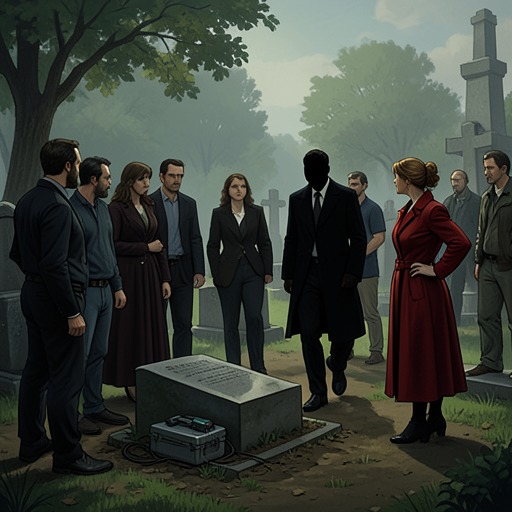
Plan to relocate the Garden of Eternal Rest cemetery
The Thursday Murder ClubThe plan to relocate the Garden of Eternal Rest is both a practical element of Ian Ventham’s development scheme and a moral dispute over what may be done to the dead. Although Father Matthew Mackie acknowledges that Ian has no legal imperative to assist him and that the council has ruled against their position, he argues that permission to move the cemetery does not excuse careless treatment of its remains. Ian intends to proceed; Mackie leaves their meeting knowing that persuasion has failed and that resistance must continue.
Background and Development Stakes
The cemetery’s proposed removal is tied to The Woodlands, which is continuing as planned despite the death of Tony Curran. Mackie had hoped that Curran’s death might bring the larger conflict to an end and spare him any further action. Instead, Ian’s decision to continue the development leaves the Garden of Eternal Rest still marked for removal. The cemetery is therefore not a separate dispute that can be settled by the change in circumstances around Curran: it remains embedded in Ian’s development plans.
Ian has already received the necessary council ruling to proceed. Mackie explicitly recognizes that Ian is not legally required to help preserve the burial ground, and says that he accepts the ruling even while disagreeing with it. His appeal is consequently not that Ian lacks permission, but that permission does not settle the moral question. He asks Ian to meet him face to face and seek a compromise, presenting the cemetery’s continued existence as an obligation of conscience rather than a legal entitlement.
The Proposed Removal and Its Contractors
Ian assures Mackie that the bodies will be moved with care and respect, but privately recognizes that this assurance is not strictly true. A public tender produced three bids. One came from the University of Kent Forensic Anthropology Department; another came from a Rye firm of cemetery specialists that had recently relocated thirty graves for a Pets at Home site and supplied photographs of workers digging by hand. The winning proposal came from Angels in Transit – the Cremoval Specialists, a company established only two months earlier by Ian with associates. Its pitch was extremely competitive, and it secured the work.
The selection exposes a gap between Ian’s public reassurance and the way he has arranged the job. He has looked up cemetery excavation online and concludes that it is not especially difficult; his confidence rests not on demonstrated experience in the evidence presented, but on the assumption that the work is straightforward. The graveyard’s age and the likely condition of its contents make that assumption consequential. Mackie notes that some graves are nearly one hundred and fifty years old, and warns that the excavation may uncover not intact coffins or complete skeletons but loose, broken, scattered, and partly decayed bones.
Mackie’s Objection and Ian’s Response
Mackie’s central demand is specific: every fragment from every grave must be found, documented, and treated with respect. He presents this as basic decency, while also stressing that it is a legal requirement. His argument thus joins reverence for the dead to the practical duties of excavation. The remains cannot be treated as interchangeable material merely because bodies have broken down over time; each fragment still calls for careful recovery and accounting.
He also asks Ian to leave the women where they are and let them rest. Mackie frames the request personally, as a man of God speaking to another man, and makes clear that the cemetery’s fate is his concern even if its relocation is Ian’s business. Ian offers to let him observe the work, but does not accept the request to stop it. He treats Mackie’s religious concern as a difference in belief, argues that only bones remain, and insists that he is entitled to move the cemetery and will do so. The offer to watch the excavation does not resolve the dispute: Mackie wants the women left undisturbed, not merely witnessed as they are moved.
Ian’s response places development authority against religious and ethical resistance. He casts the cemetery issue as one pressure among many on a project burdened by other complaints and regulations, while Mackie treats the burial ground as a responsibility that cannot be dismissed as another inconvenience. Their exchange ends without a compromise. Mackie warns that he will make the process as difficult as he can; Ian replies that he already faces numerous opponents and does not consider Mackie his greatest problem.
Continuation and Significance
After the meeting, Mackie walks up the hill through an avenue of trees, with the Garden of Eternal Rest visible farther along the path. Its iron gates are wide enough for a vehicle, set into a red-brick wall: the gates look old, while the wall looks new. The turning circle in front, once used by hearses, now serves maintenance vehicles. These details place the proposed relocation within a cemetery already bordered by signs of practical change, without making the removal itself complete.
Mackie’s first hope that Curran’s death would end the matter gives way to urgency when he learns that The Woodlands will proceed and the cemetery is still to go. The plan’s immediate consequence in the supplied episode is therefore not a completed excavation, but a sharpened conflict: Ian remains committed to relocation, and Mackie turns to a plan B. The episode’s ethical tension lies in the difference between moving graves lawfully and treating the dead with the care the move demands. Ian regards relocation as an authorized step in development; Mackie insists that the condition and dignity of the remains impose obligations that authorization alone cannot erase.